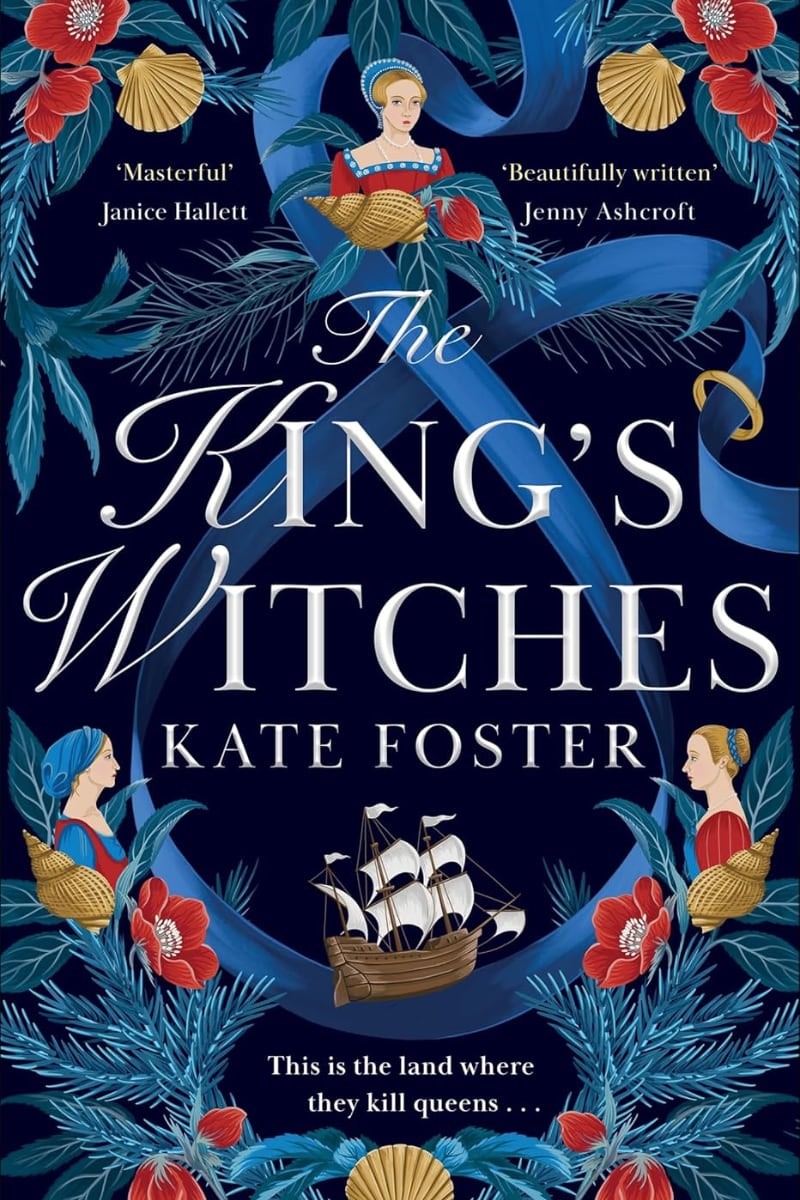
The King’s Witches by Kate Foster
Edinburgh, 1589. Princess Anna of Denmark is to wed King James VI of Scotland. First, she must pass the trial period: one year of marriage to prove herself worthy. Under the watchful eye of her loyal lady-in-waiting, Kirsten, Anna resolves to be the perfect royal bride. Until she meets Lord Henry . . .
Meanwhile, young housemaid Jura has recently fled to the capital, seeking protection and anonymity. But her newfound safety is soon threatened when she is caught up in the witchcraft mania that has gripped the country – and its new queen.
GUIDE
THEMES
A young woman is accused of being a witch.
SETTING
Set in Denmark and Scotland in the 16th century.
SERIES
Not part of a series.
Review
The King’s Witches is a novel that explores the witch trials that were prevalent in the sixteenth century and also explores the paranoia that affected King James VII of Scotland. The novel begins in Denmark where Princess Anna is preparing for her marriage by proxy to James with the Scottish ambassador, Earl Marischal, standing in for the king. When Anna sets sail for Scotland, her ship is beset by violent storms which force her to turn back several times. Growing impatient, James heads to Denmark himself to escort his new queen to Scotland but while there he is told outlandish tales of witches causing havoc in Denmark and that they may have been responsible for the storms that have prevented Princess Anna from reaching Scotland.. The tales frighten James to the extent that he how believes the witches are conspiring against him and is keen to hunt them down.
In North Berwick, a young woman, Jura, is working as a housemaid for the Kincaid family but she is forced to leave in the middle of the night to avoid her master’s unwanted attentions. Jura has inherited her mother’s skills for using healing herbs and has used them to help the women in the area, but she uses her skill to incapacitate her master one evening and it works better than she planned when he becomes gravely ill. Realising she will be blamed for trying to kill him, Jura flees to Edinburgh to live with her aunt who is skilled at reading cards. Jura is warned to keep her talents hidden as there are rumours of women being rounded up and accused of witchcraft. However, Jura finds her fate is very much tied to one of Princess Anna’s household.
While the chapters are told from the point of view of Princess Anna and Jura, we also hear from Kristen who is a lady in waiting to the princess and travelling with her to Scotland. Kirsten is no stranger to Scotland and is sending secret messages to others to warn of the danger that they face from the witch hunts. It is Kirsten’s mysterious connection to Jura that forms the heart of the story and that is the most interesting part even though you have to suspend belief a little for it to work. The least interesting part is the romance that has been fabricated between Princess Anna and the Earl Marischal which is entirely unnecessary. Princess Anna never comes across as believable in my book and the author has deviated greatly from historical fact to make it fit.
The witch aspect is much more exciting and it alludes to the North Berwick trials which is connected to Jura even though she is a fictional character. The storms that kept Princess Anna from reaching Scotland are a factual account of her journey and James VI really did blame witches for it. James’ paranoia was all too real and he wrote Daemonologie in 1597 which was a study of demonology and he also supervised the torture of women which is shown in the novel. Although James eventually became more sceptical of witches, the persecutions would continue in Scotland well into the eighteenth century and it is estimated that 4,000 to 6,000 people were tried. Most of those executed were women and it that number is thought to be around 1,500. In 2022, the Scottish government issued a formal apology to those accused under the Witchcraft Act.
More by Kate Foster
No posts