Review
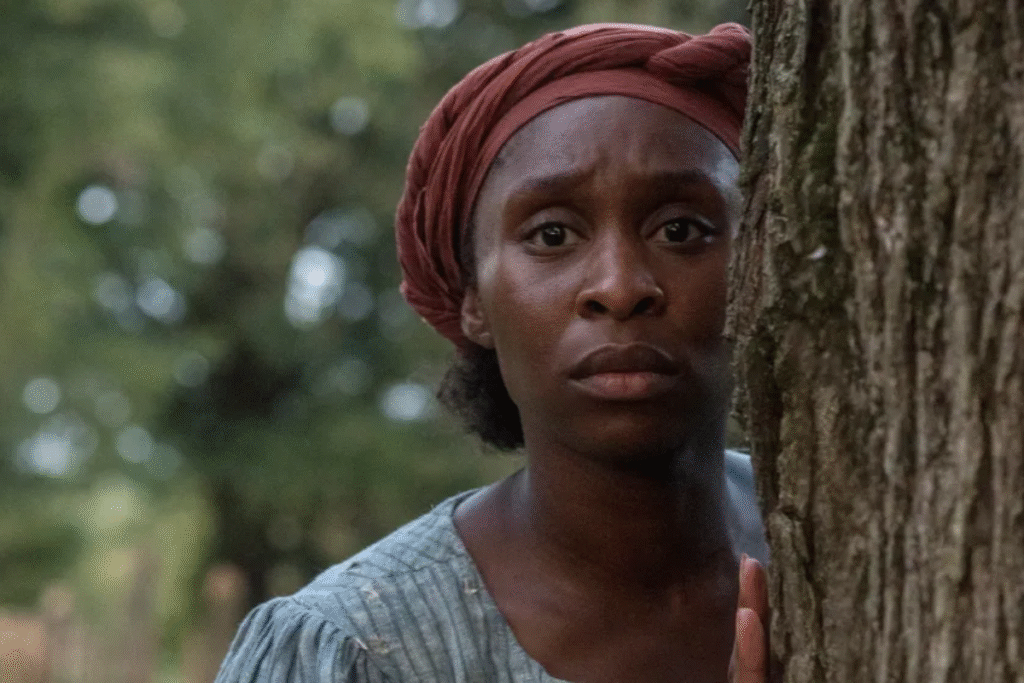
Harriet is an 2019 American biographical film directed by Kasi Lemmons who also wrote the screenplay with Gregory Allen Howard. The film stars Cynthia Erivo as Harriet Tubman, with Leslie Odom Jr as William Still, Joe Alwyn as Gideon Brodess, and Janelle Monáe as Marie Buchanon.
The film begins in 1849 when Harriet (Cynthia Erivo) is newly married to John Tubman (Zackary Momoh), a free man who works on a neighbouring plantation, and the couple hire a lawyer to force Harriet’s owner, Edward Brodess, to honour a previous will that stated Harriet’s mother, Rit (Vanessa Bell Calloway), and her issue were to be freed when Rit turned 45 years. The request is denied and a furious Harriet prays for God to kill Edward Brodess but is caught by his son, Gideon (Joe Alwyn). When Edward dies soon after, a spiteful Gideon arranges to sell Harriet but she decides to escape. Harriet is pursued by Gideon but she jumps from a bridge into a river and is presumed drowned.
Harriet makes it to Wilmington, Delaware, where a local abolitionist helps her cross the border into Pennsylvania and she is helped by William Still (Leslie Odom Jr), the chairman of the Pennsylvania Anti-Slavery Society. Changing her name formally to Harriet, she finds lodgings with Marie Buchanon (Janelle Monáe) but she cannot rest until she frees her family. Harriet pleads with William to help her bring her family north but he refuses as it is becoming increasingly harder to help slaves escape. Undeterred, Harriet heads south and is devastated when she discovers her husband has married a free woman and they are having a child. Undeterred, Harriet leads a group of slaves to freedom and becomes part of the Underground Railway.
Eventually, Harriet manages to free most of her family but her sister, Rachel (Deborah Ayorinde), refuses to leave Gideon’s farm as he has sold her children and won’t tell her where they are. Under duress, Rachel admits to Gideon that Harriet is the one leading the slaves away and he furiously tracks her down to Philadelphia to reclaim her as his property. Harriet escapes to Canada with her family but makes one more trip south to bring her parents, now freed, and Rachel to Canada. However, Harriet learns Gideon’s farm has fallen into financial ruin and Rachel has died. Gideon’s mother, Eliza (Jennifer Nettles) blames Harriet for her husband’s death, and tries to use Rachel’s children to lure Harriet into a trap but it fails.
When Harriet has her final confrontation with Gideon, she lets him live but prophesies that he will die in battle fighting for a lost cause. As the Civil War breaks out, Harriet uses her skills to lead an armed expedition of 150 black soldiers in the Combahee River Raid. The film ends as Harriet makes her way back home and is greeted by her family while an epilogue recounts her accomplishments during the Civil War and as an advocate for women’s suffrage in her later years.
Cynthia Erivo was nominated for an Academy Award for her portrayal as Harriet Tubman and it is easy to see why as her outstanding performance saves this film from mediocrity. The film is a faithful rendition of Harriet’s life but it misses out her early years as a slave other than a few flashbacks to the head injury that apparently left her with the ability to hear what she perceives are messages from God. In the film, Harriet decides to escape when she learns she is about to be sold by Gideon Brodess who has inherited the farm after the death of his father but she escapes alone whereas in reality she was with two of her brothers who convinced her to turn back for fear their families would be harmed. It was Harriet’s second attempt that was the successful one.
The film also blends real life people, such as William Still, with invented characters like Gideon Brodess and Marie Buchanon. The Brodess family who owned Harriet and her siblings did not have a son named Gideon and after Edward Brodess died, the farm was inherited by his widow who was forced to sell some of the slaves as the farm was in financial trouble. Gideon is introduced as a foil to Harriet who pursues her relentlessly throughout the film but is completely unnecessary in my opinion. Harriet’s activities as part of the Underground Railway would have added plenty of dramatic tension on their own particularly as the stakes grew higher with the passing of The Fugitive Slave Acts in 1850 which allowed runaway slaves to be returned to their original owners.
The epilogue gives us an account of Harriet’s exploits during the Civil War and her later involvement in women’s suffrage, however it just leaves you with the impression this film barely scratches the surface of the life of a remarkable woman.